
The U.S. Supreme Court resolved a long-simmering circuit split on June 4 when it unanimously held in Sripetch v. U.S. Securities and Exchange Commission that the SEC need not prove investors suffered pecuniary loss to obtain disgorgement, but it also sharpened the practical question in fraud litigation.
Disgorgement exists to strip a wrongdoer of unjust enrichment, the court reaffirmed, not merely to compensate victims for what they lost. That shifts the forensic accounting question at the center of many fraud cases from “what did the investors or the counterparty lose” to “what did the wrongdoer actually gain,” a related but often more granular and more document-intensive calculation.
The shift is not confined to SEC enforcement actions. Shareholder disputes, breach of fiduciary duty claims and private fraud litigation increasingly rely on the same unjust-enrichment framing, and the underlying forensic work is largely the same regardless of the theory: identifying how the numbers were manipulated in the first place.
For litigators who do not handle these matters daily, the challenge is recognizing which fact patterns signal manipulation early, before key documents are gone and deposition testimony locks witnesses into an unhelpful narrative.
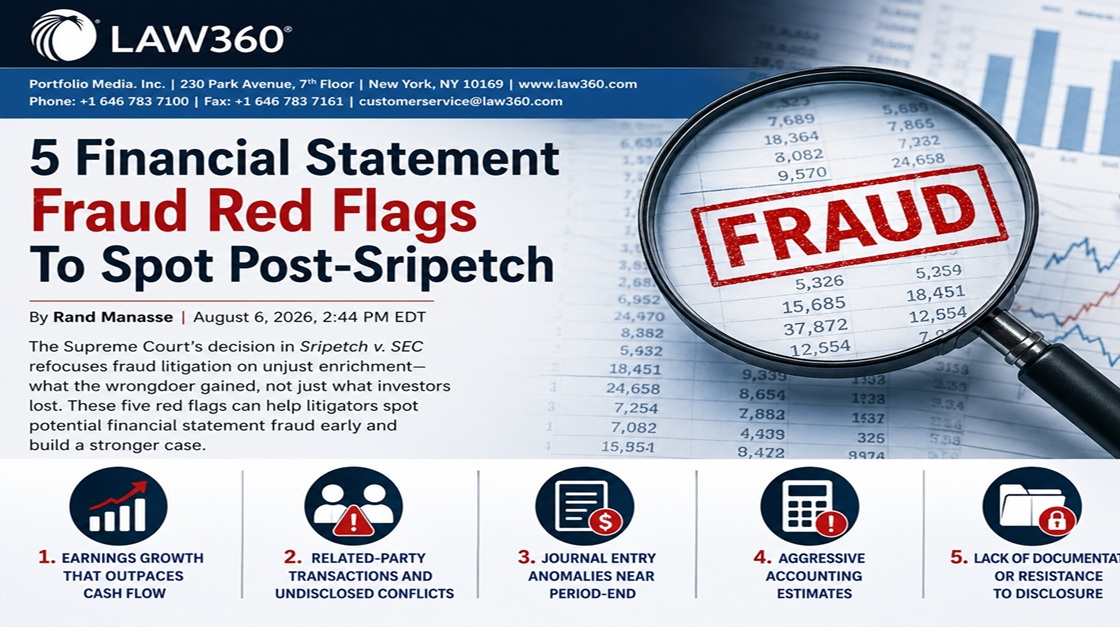
The following five red flags are drawn from common patterns in financial statement fraud and forensic investigations. None of them, standing alone, proves wrongdoing. But when one or more appears in a client’s or an adversary’s financials, it usually warrants a closer look, one that should shape discovery strategy and deposition preparation, and, in the post-Sripetch landscape, how gain gets quantified as rigorously as loss.
1. Earnings Growth That Outpaces Cash Flow
Revenue and earnings before interest, taxes, depreciation and amortization are accounting constructs; cash is not. When a company reports steadily rising earnings while operating cash flow stays flat or declines, the gap is often explained by aggressive revenue recognition, channel stuffing or capitalization of expenses that should have been run through the income statement.
This pattern shows up constantly in M&A disputes, where a seller’s adjusted EBITDA becomes the centerpiece of a postclosing purchase price dispute, and it is frequently the same adjusted EBITDA figure a forensic accountant later has to unwind to isolate what a wrongdoer actually gained from the manipulation.
Litigation Relevance
Request the company’s monthly cash flow statements, not just the annual audited version; accounts receivable aging reports; and any internal adjusted EBITDA reconciliations prepared for lenders or a sale process. The reconciling items between generally accepted accounting principles earnings and the adjusted figure are frequently where the dispute lives.
2. Related-Party Transactions and Undisclosed Conflicts
Transactions between a company and its officers, directors or their affiliated entities are not inherently improper, but they are a leading vehicle for asset diversion, self-dealing and breach of fiduciary duty claims. Watch for financial or customer relationships where the counterparty’s ownership is not disclosed in the financials, unusually favorable payment terms extended to an insider-controlled entity, or management fees and consulting arrangements that were never put before an independent board committee.
Litigation Relevance
Corporate formation documents, related-party disclosure schedules, and board or committee minutes approving (or failing to approve) insider transactions are the first documents to preserve. In private company disputes, cap tables and affiliate ownership records often reveal relationships the financial statements themselves do not disclose.
3. Journal Entry Anomalies Near Period-End
A disproportionate volume of manual journal entries booked in the final days of a reporting period, entries made by someone outside the normal accounting function or round-dollar entries lacking supporting documentation are classic indicators of management override of internal controls, still the most common fraud scheme identified in forensic investigations.
This is true whether the dispute involves a public company restatement or a closely held business in a shareholder buyout fight.
Litigation Relevance
General ledger detail with user ID and time-stamp metadata, not just summary trial balances, allows a forensic accountant to identify who made which entries and when. Where the underlying accounting system supports it, an audit trail export should be an early discovery request, since native-format ledger data is far more probative than PDF exports of financial statements.
4. Revenue Recognition Timing Games
Bill-and-hold arrangements, side letters granting return rights, or extended payment terms that are not reflected in the recognized revenue on contracts with contingencies still outstanding are recurring patterns in financial statement fraud, particularly in the periods immediately before a financing round, a sale process or a covenant compliance test.
Litigation Relevance
Request underlying customer contracts and any side letters or email correspondence with sales or finance personnel around quarter-end, not just the revenue recognized in the general ledger. Discrepancies between the contract terms and the recognized revenue are often the clearest evidence in these disputes.
5. Inventory and Asset Valuation That Doesn’t Match Operations
Inventory or asset values that increase while sales volumes, production or utilization data show a decline are common red flags in both fraud investigations and bankruptcy or insolvency matters, where overstated asset values can materially affect a going-concern or solvency analysis.
Impairments that are delayed or avoided altogether despite clear operational deterioration are equally significant.
Litigation Relevance
Operational data, production logs, utilization reports, physical inventory counts and appraisals should be requested alongside the financial statements themselves, since it is the mismatch between the operational reality and the reported financial position that usually establishes the claim.
Building the Record Under Sripetch
The most common mistake is waiting until the discovery record is already set to focus on these patterns. Spotting them early lets litigators shape document requests toward the right custodians, target the electronically stored information most likely to disappear or become harder to authenticate over time, and build deposition outlines for the chief financial officer, controller or outside auditor around the numbers, rather than after that testimony has already locked in an unhelpful narrative.
Sripetch v. SEC does not change the underlying work of spotting these five patterns. It changes what that work needs to prove. An analysis built to establish investor loss is not automatically sufficient to establish a wrongdoer’s gain, and the two figures can diverge significantly depending on how the fraud was structured.
None of the five patterns above requires an accounting background to spot in a first read of the financials. What they require is knowing when a departure from normal business operations is significant enough to warrant a closer, forensic-level look, and building that record, through targeted discovery, document preservation and deposition preparation, before the theory of damages or disgorgement is already set.
Rand M. Manasse is the managing partner at Green Lane Partners. This article originally appeared in Law360.
Leave a Reply